Middleware flow
Summary
A diagram of the default middleware pipeline in Dotkernel API, showing the order in which middlewares process an incoming request and the response on the way back out.
Details
The graph below demonstrates a default flow between Dotkernel's middlewares.
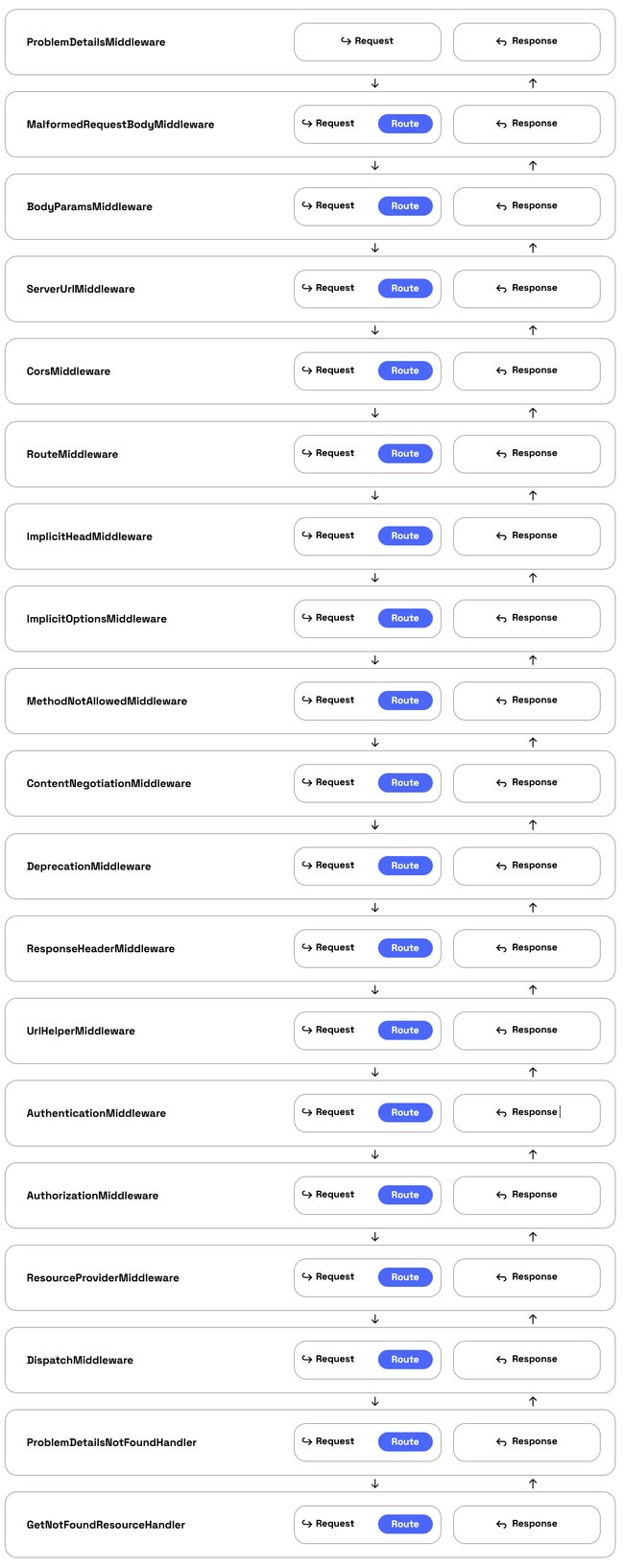
Dotkernel API 7.1 and 7.2 pipe
MalformedRequestBodyMiddlewareright afterProblemDetailsMiddleware, so a malformed request body produces a400 Bad Requestresponse. The diagram does not show it, and version 7.0 does not have it. Update to the latest Dotkernel API 7.x release to get it, see Upgrading from 7.0 to 7.1.
FAQ
Q: Why does middleware order matter?
A: Each middleware may short-circuit the request or add attributes the next one relies on. For example, authentication must run before authorization, because authorization needs the resolved identity.
Q: Where is the pipeline defined?
A: In config/pipeline.php.
That file is the authoritative order; the diagram is a visual summary of it.
Q: How do I add my own middleware?
A: Register it in the container, then insert it into config/pipeline.php at the position where it needs to run, or attach it to a specific route.
Q: Which middlewares are responsible for authentication and authorization?
A: AuthenticationMiddleware and AuthorizationMiddleware.
See Authentication and Authorization.
Q: What happens when a middleware throws?
A: The error handling middleware at the top of the pipeline converts it into a Problem Details response. See Problem Details.