The new handler structure
Summary
Since version 6.0 Dotkernel API uses PSR-15 handlers instead of multi-action controllers, with each handler responsible for a single request. This page explains what a handler is, the naming pattern that encodes method, resource and action into the class name, and where to find the full handler mapping.
Details
Since version 6.0, Dotkernel API contains some new architectural changes compared to its older version that uses controllers. The goal of this update is to implement PSR-15 handlers into Dotkernel API.
What is a handler?
A "handler" is the piece of code that reacts when a user makes a specific request (like visiting a webpage or submitting a form). It's basically the "controller" that decides what happens next.
HTTP request handlers are at the core of any web application. They receive a request, process it and return a response.
Controllers with several actions are fine, but handlers split the code into manageable chunks that make your life a lot easier in the long run. This follows the first of the SOLID principles.
What is a naming pattern?
A naming pattern helps you organize and quickly identify your files by using relevant strings in file names like:
- What a file refers to.
- The action a file performs.
- How a file relates to other files.
- The author of the file’s contents.
- The creation date or the event the file refers to.
The naming pattern for Dotkernel Handlers
The naming pattern for our Handlers contains:
- The method or verb used by the handler (e.g., GET, POST).
- The resource name (e.g., Admin, Account).
- The performed action (e.g., CreateForm, List).
- An optional Form if the handler returns a form that will perform another action when submitted.
- The string Handler.
In this way, the developer can easily figure out the functionality of each handler by looking at its name.
Mapping of the handlers
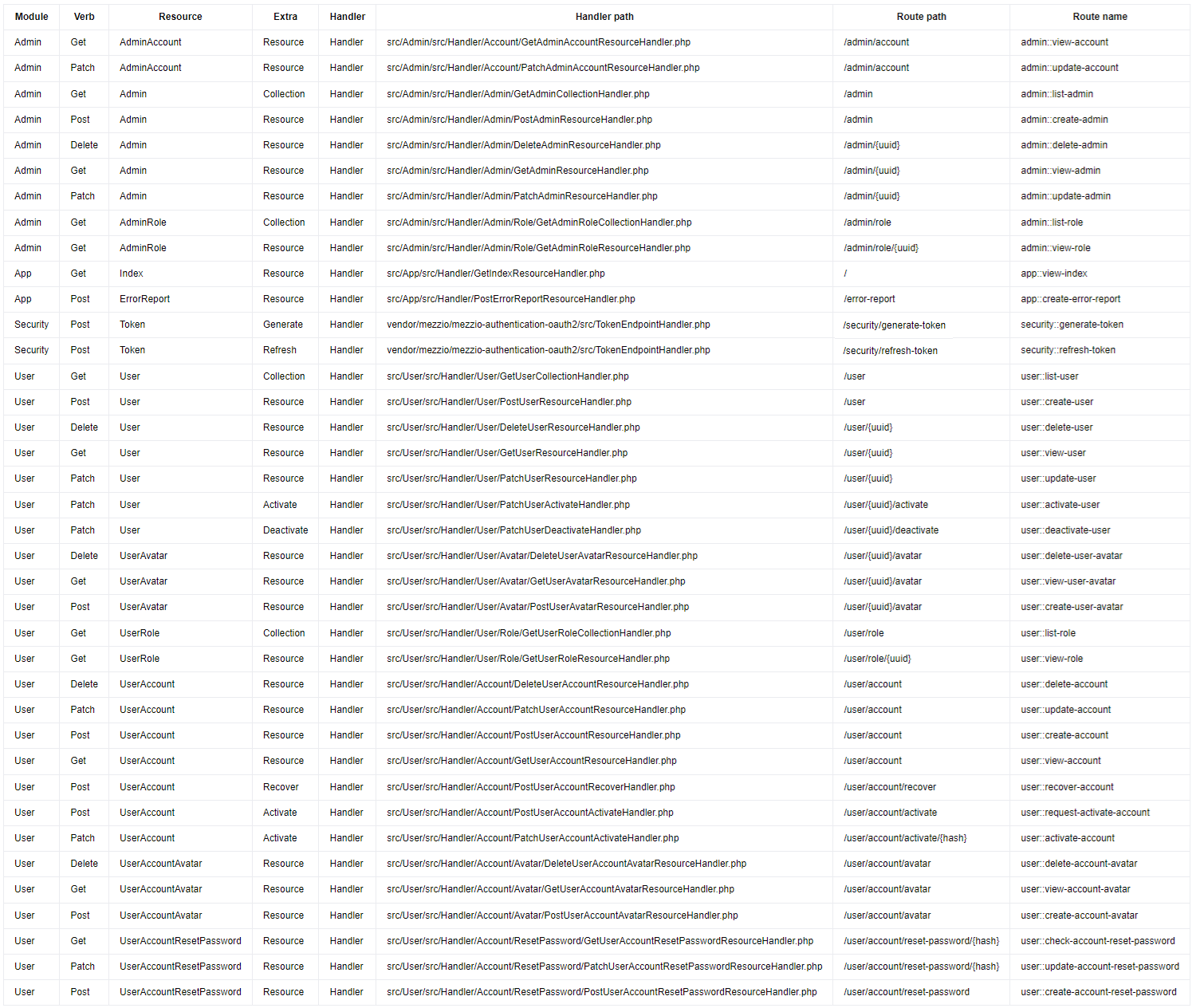
The full mapping of the handlers and their current paths and actions can be found in the full naming convention table.
FAQ
Q: How is a handler different from a controller?
A: A controller groups several actions in one class; a handler deals with a single request and returns a response. Splitting them keeps each class to one responsibility, following the single-responsibility principle.
Q: What should I name a handler that creates an admin via POST?
A: Follow the pattern of method, resource, action and the Handler suffix — for example PostAdminResourceHandler.
The name alone should tell a reader what the class does.
Q: When is Form part of the name?
A: Only when the handler returns a form that will trigger another action on submission.
Q: Do handlers have to extend a base class?
A: Dotkernel's handlers extend AbstractHandler, which supplies shared response helpers.
Implementing RequestHandlerInterface directly also works.
Q: Where do I see all existing handlers and their routes?
A: In the naming convention table.
Q: How do handlers receive their dependencies?
A: Through constructor injection, declared with the #[Inject] attribute.
See Injectable input filters and Dependency injection.