How the ConfigProvider works
Summary
Walks through how the ConfigProvider is picked up during bootstrap, merged, resolved, and executed within the Mezzio middleware pipeline.
Details
The ConfigProvider is automatically picked up by the framework during application bootstrap. Let's look at it step by step:
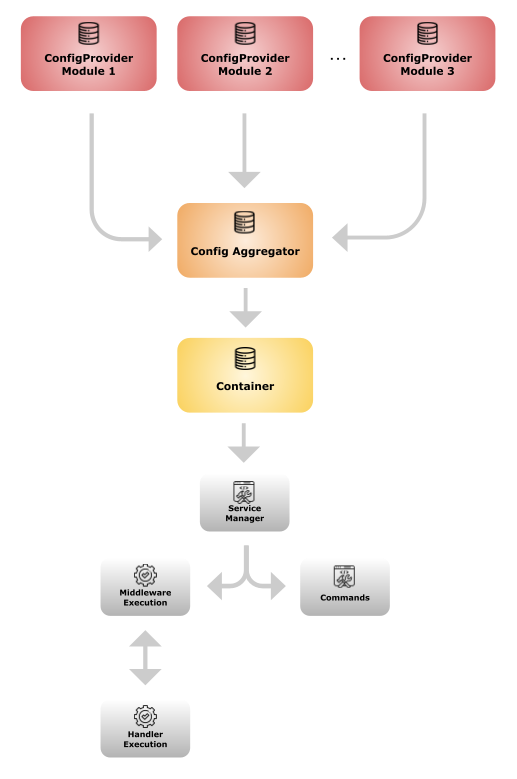
- Merge the global configuration - All ConfigProviders are merged into one array.
- Read the configuration array - The call is similar to the below and expects an array of entries:
$config = $container->get('config')['key'] ?? [];- Resolve item -
$app->pipe()is called to resolve one of the below instances:- Resolve the service name from the container
- Wrap the middleware, if an array is provided
- Call the closure or invokable object.
- Handle errors - This middleware is the last one in the pipeline to make sure it handles any exceptions.
- Execute at runtime - Laminas Stratigility iterates over the pipeline in the order it was registered.
- Each middleware can handle the request and return a response, or delegate execution to the next middleware in the pipeline, until a
ResponseInterfaceis returned to the client.
- Each middleware can handle the request and return a response, or delegate execution to the next middleware in the pipeline, until a
Below you can see how Mezzio and Dotkernel merge and use ConfigProviders to build the middleware pipeline and dependencies.
FAQ
Q: When is the ConfigProvider picked up?
A: Automatically, by the framework during application bootstrap.
Q: What happens during the "Resolve item" step?
A: $app->pipe() resolves a service name from the container, wraps a middleware array, or calls a closure/invokable object.
Q: Why does the error-handling middleware run last in the pipeline?
A: So it can catch any exceptions raised by the preceding middleware.